


 Cart
Cart
 sales@molnova.com



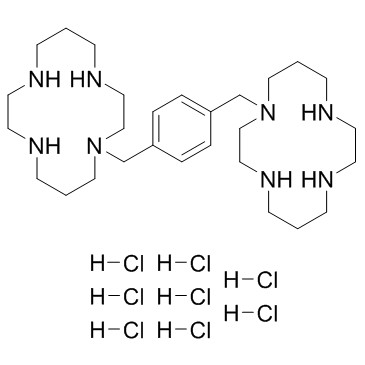
Plerixafor octahydrochloride
CAS No. 155148-31-5
Plerixafor octahydrochloride( AMD-3100 octahydrochloride | JM-3100 octahydrochloride | SID-791 octahydrochloride )
Catalog No. M12205 CAS No. 155148-31-5
Plerixafor?octahydrochloride (JM-3100, AMD-3100, SID-791) is a potent, selective CXCR4 inhibitor (IC50=44 nM) that inhibits the replication of various HIV-1 and HIV-2 strains in various cell lines with EC50 of 10ng/ml.
Purity : >98% (HPLC)
 COA
Datasheet
HNMR
HPLC
MSDS
Handing Instructions
COA
Datasheet
HNMR
HPLC
MSDS
Handing Instructions
| Size | Price / USD | Stock | Quantity |
| 5MG | 38 | In Stock |


|
| 10MG | 52 | In Stock |
|
| 25MG | 95 | In Stock |
|
| 50MG | 161 | In Stock |
|
| 100MG | 293 | In Stock |
|
| 200MG | 462 | In Stock |
|
| 500MG | 736 | In Stock |
|
| 1G | Get Quote | In Stock |
|
Biological Information
-
Product NamePlerixafor octahydrochloride
-
NoteResearch use only, not for human use.
-
Brief DescriptionPlerixafor?octahydrochloride (JM-3100, AMD-3100, SID-791) is a potent, selective CXCR4 inhibitor (IC50=44 nM) that inhibits the replication of various HIV-1 and HIV-2 strains in various cell lines with EC50 of 10ng/ml.
-
DescriptionPlerixafor?octahydrochloride (JM-3100, AMD-3100, SID-791) is a potent, selective CXCR4 inhibitor (IC50=44 nM) that inhibits the replication of various HIV-1 and HIV-2 strains in various cell lines with EC50 of 10ng/ml; can produce mesenchymal stem cells and endothelial progenitor cells in mice in combination with VEGF; also is an allosteric agonist of CXCR7.Multiple Sclerosis Preclinical(In Vitro):The CXCR4 inhibitor Plerixafor (AMD3100) is a potent inhibitor of CXCL12-mediated chemotaxis (IC50, 5.7 nM) with a potency slightly better than its affinity for CXCR4. Treating the cells with CCX771 or CXCL11 has no effect on CXCL12-mediated MOLT-4 or U937 TEM. In contrast, 10 μM Plerixafor inhibits CXCL12-mediated TEM in both cells lines. Plerixafor (10 μM)-treated cells show a moderate reduction in cell proliferation compared to CXCL12-stimulated cells, which do not reach statistical significance. (In Vivo):Plerixafor (2 mg/kg) administration to UUO mice exacerbates renal interstitial T cell infiltration, resulting in increased production of the pro-inflammatory cytokines IL-6 and IFN-γ and decreased expression of the anti-inflammatory cytokine IL-10. Both perivascular and interstitial fibrosis are significantly reduced by the CXCR4 antagonist, Plerixafor (AMD3100) at 8 weeks. LD50, mouse, SC: 16.3 mg/kg; LD50, rat, SC: >50 mg/kg; LD50, mouse and rat, IV injection: 5.2 mg/kg.
-
In VitroThe CXCR4 inhibitor Plerixafor (AMD3100) is a potent inhibitor of CXCL12-mediated chemotaxis (IC50, 5.7 nM) with a potency slightly better than its affinity for CXCR4. Treating the cells with CCX771 or CXCL11 has no effect on CXCL12-mediated MOLT-4 or U937 TEM. In contrast, 10 μM Plerixafor inhibits CXCL12-mediated TEM in both cells lines. Plerixafor (10 μM)-treated cells show a moderate reduction in cell proliferation compared to CXCL12-stimulated cells, which do not reach statistical significance.
-
In VivoPlerixafor (2 mg/kg) administration to UUO mice exacerbates renal interstitial T cell infiltration, resulting in increased production of the pro-inflammatory cytokines IL-6 and IFN-γ and decreased expression of the anti-inflammatory cytokine IL-10. Both perivascular and interstitial fibrosis are significantly reduced by the CXCR4 antagonist, Plerixafor (AMD3100) at 8 weeks. LD50, mouse, SC: 16.3 mg/kg; LD50, rat, SC: >50 mg/kg; LD50, mouse and rat, IV injection: 5.2 mg/kg.
-
SynonymsAMD-3100 octahydrochloride | JM-3100 octahydrochloride | SID-791 octahydrochloride
-
PathwayGPCR/G Protein
-
TargetChemokine Receptor
-
RecptorCXCL12|CXCR4
-
Research AreaInflammation/Immunology
-
IndicationMultiple Sclerosis
Chemical Information
-
CAS Number155148-31-5
-
Formula Weight794.4695
-
Molecular FormulaC28H62Cl8N8
-
Purity>98% (HPLC)
-
SolubilityH2O: ≥ 42 mg/mL
-
SMILESC1CNCCNCCCN(CCNC1)CC2=CC=C(C=C2)CN3CCCNCCNCCCNCC3.Cl.Cl.Cl.Cl.Cl.Cl.Cl.Cl
-
Chemical Name1,4,8,11-Tetraazacyclotetradecane, 1,1'-[1,4-phenylenebis(methylene)]bis-, hydrochloride (1:8)
Shipping & Storage Information
-
Storage(-20℃)
-
ShippingWith Ice Pack
-
Stability≥ 2 years
Reference
1. Zabel BA, et al. J Immunol. 2009, 183(5), 3204-3211.
2. De Clercq E, et al. Antimicrob Agents Chemother. 1994 Apr;38(4):668-74.
3. Pitchford SC, et al. Cell Stem Cell. 2009 Jan 9;4(1):62-72.
molnova catalog



related products
-
NVP-BDZ 824
A potent, highly selective antagonist of chemokine receptor CXCR3 with binding IC50 of 146 nM, Ca2+-mobilization IC50 of 28 nM.
-
BMS-22
A potent, selective, allosteric CCR2 antagonist with binding IC50 of 5.1 nM.
-
GW-766994
GW-766994 (GW766994) is a potent, selective, orally available CCR3 antagonist.
